Oil Change Cost vs. Risk Calculator
Vehicle & Oil Specifications
Analysis Results
Enter your details and click Calculate to see the breakdown.
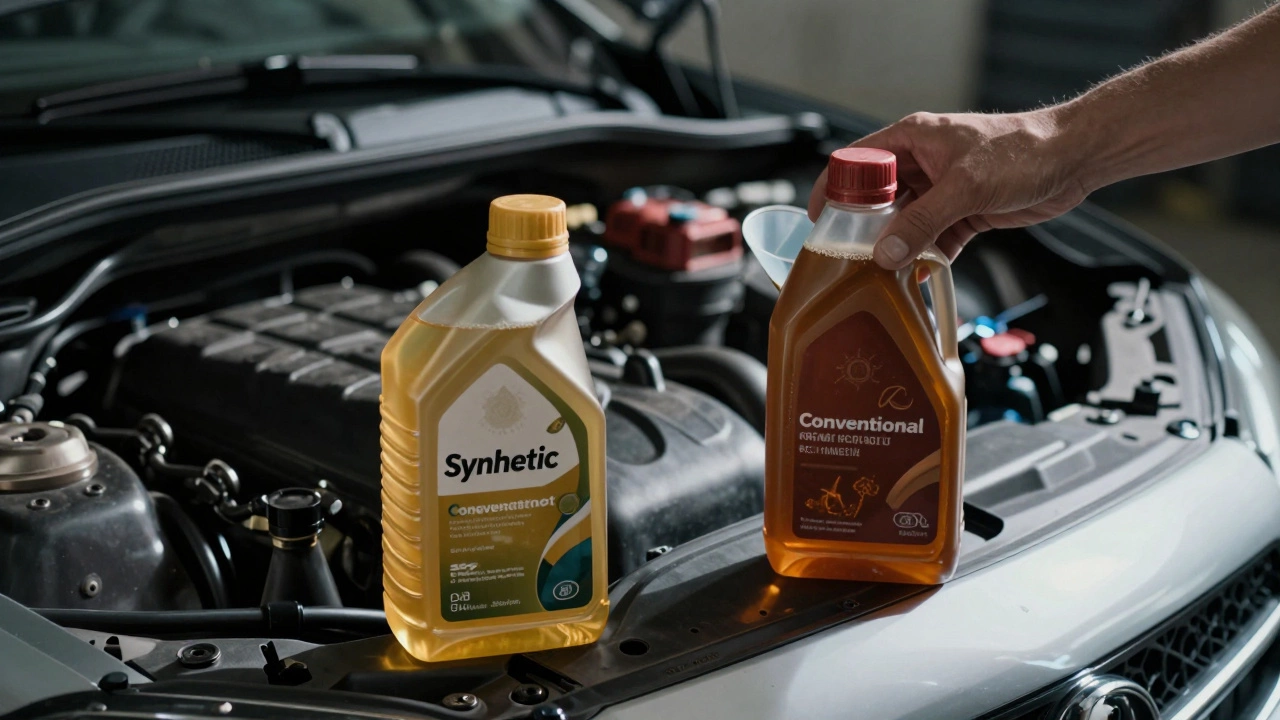
Imagine you’re halfway through an oil change in your driveway. The bottle of Synthetic Oil is a high-performance lubricant engineered with uniform molecular structures for superior protection and longevity is empty, but you have a quart of conventional mineral oil sitting on the garage shelf. Do you pour it in? Or do you drive to the shop? This scenario happens more often than you might think. Whether it’s an emergency top-up or a cost-cutting mistake at a quick-lube shop, mixing these two types of fluid raises serious questions about your engine's health.
The short answer is that putting regular oil into an engine designed for synthetic usually won’t cause immediate catastrophic failure, but it does degrade performance. It’s like swapping premium fuel for regular gas in a high-performance car-it runs, but not as well as it should. To understand why this matters, we need to look at what actually happens inside your engine when these chemically distinct fluids meet.
The Chemistry Gap: Why They Are Different
To grasp the risk, you first need to understand the fundamental difference between the two products. Conventional oil, often called Mineral Oil is crude oil refined from petroleum, containing natural impurities and irregular molecular sizes, is essentially crude oil that has been cleaned up. Because it comes from nature, its molecules are all different shapes and sizes. Think of it like a bag of mixed nuts-some big, some small, some jagged.
In contrast, synthetic oil is manufactured. Chemists take base oils and refine them until the molecules are uniform. Imagine a bag of perfectly spherical marbles instead of mixed nuts. These uniform molecules slide past each other with less friction, handle extreme temperatures better, and resist breaking down over time. When you mix them, you aren’t just diluting the quality; you are introducing chaos into a highly ordered system.
| Feature | Synthetic Oil | Conventional (Regular) Oil |
|---|---|---|
| Molecular Structure | Uniform, engineered | Irregular, natural variation |
| Viscosity Stability | High (stable in heat/cold) | Low (thins in heat, thickens in cold) |
| Additive Package | Advanced detergents & dispersants | Basic cleaning agents |
| Lifespan | 7,500-10,000+ miles | 3,000-5,000 miles |
| Cost per Quart | $3.00 - $6.00 | $2.00 - $4.00 |
Immediate Effects: Viscosity and Friction
When you introduce conventional oil into a synthetic-filled engine, the most immediate change occurs in Viscosity is the measure of a fluid's resistance to flow, determining how thick or thin the oil is at operating temperatures. Modern engines are built with incredibly tight tolerances. Synthetic oil maintains its thickness even under high heat. Conventional oil tends to break down faster, becoming thinner when hot and thicker when cold.
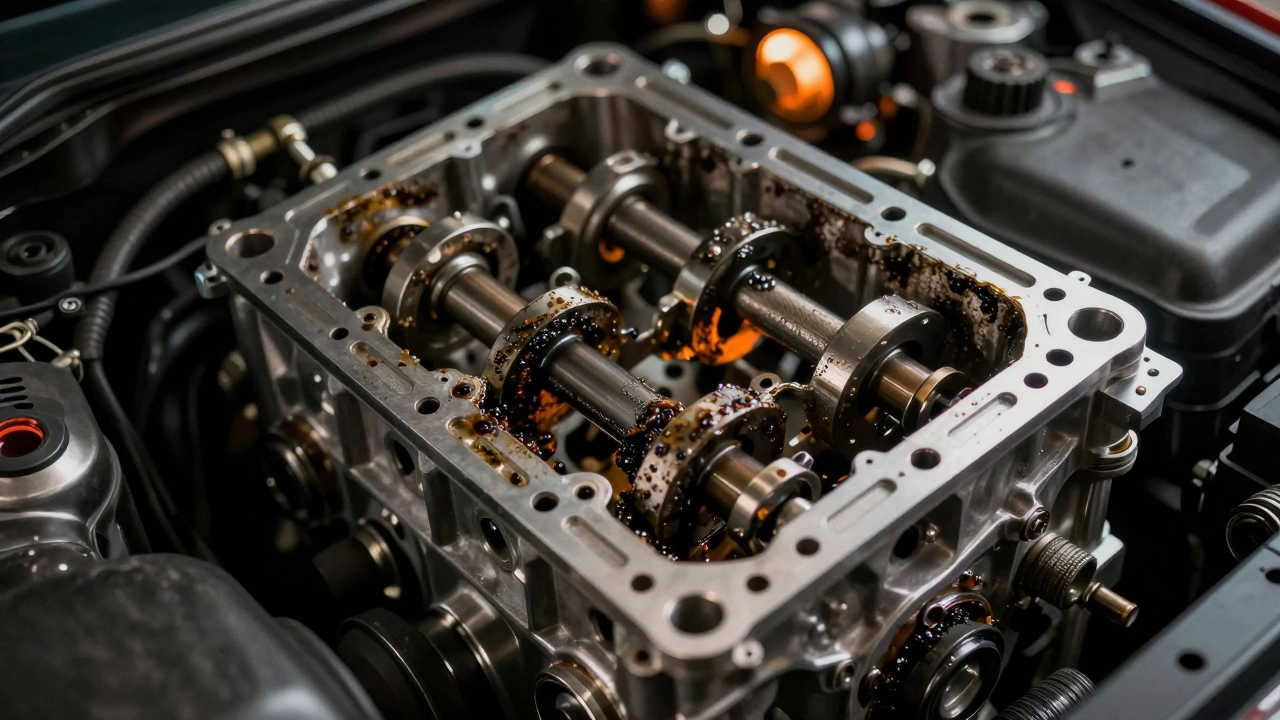
If you mix them, the resulting blend will likely have lower thermal stability than pure synthetic. In a hot summer commute or while towing a trailer, the oil may shear down more quickly. This means the protective film between moving parts becomes weaker. You might not feel this happening, but the microscopic wear on your camshaft lobes and crankshaft bearings increases. Over time, this accelerated wear can lead to reduced engine life and higher noise levels.
Long-Term Risks: Sludge and Deposits
The bigger problem isn't just friction; it’s cleanliness. Synthetic oils contain advanced additive packages designed to suspend contaminants and keep the engine clean. Conventional oils have simpler additives. When you mix them, you dilute the effectiveness of the detergent and dispersant additives in the synthetic oil.
This dilution can lead to the formation of sludge and varnish deposits. Sludge is a thick, tar-like substance that clogs oil passages. If the oil pump cannot push enough oil through these clogged channels, critical components starve for lubrication. While this rarely happens overnight, doing this repeatedly or leaving a mixed batch in the engine for thousands of miles significantly raises the risk of internal engine damage. For older engines with existing sludge issues, switching back and forth can sometimes dislodge old deposits, causing blockages in the oil pickup screen-a potentially fatal error for the engine.

Warranty and Manufacturer Guidelines
Many modern vehicles, especially those from European manufacturers like BMW, Mercedes-Benz, and Audi, require specific synthetic oil standards (such as ACEA C3 or API SP). Using conventional oil in these engines violates the manufacturer’s maintenance schedule. If your engine suffers premature failure and you can prove that non-specified oil was used, your warranty claim could be denied. Dealerships often check oil records during warranty inspections. Even if they don’t find the exact bottle, evidence of improper maintenance practices can void coverage.
For American-made trucks and SUVs, the rules are sometimes looser, but many still recommend full synthetic for turbocharged engines. Turbochargers spin at speeds exceeding 100,000 RPM and generate immense heat. They rely heavily on the superior heat resistance of synthetic oil. Putting regular oil in a turbo engine is one of the fastest ways to destroy the turbocharger due to oil coking-the process where oil burns and turns into carbon deposits on the turbo shaft.
Is Mixing Ever Safe?
Here is the nuance that many mechanics will tell you: mixing synthetic and conventional oil is generally safe for short-term use or emergencies. Most major oil brands formulate their synthetic and conventional lines to be compatible. If you are stranded and need to add a quart to reach the next service station, go ahead. The engine would rather run with slightly diluted protection than no oil at all.
However, "safe" does not mean "optimal." If you regularly mix them, you defeat the purpose of paying extra for synthetic. You lose the extended drain intervals, the better cold-start protection, and the enhanced fuel economy. It is a compromise that costs you money in the long run through increased wear and more frequent changes.
What Should You Do If It Already Happened?
If you accidentally put regular oil in your synthetic engine, don’t panic. Drive normally to a mechanic or perform an oil change as soon as possible. Here is the step-by-step approach:
- Check the Level: Ensure the oil level is within the safe range on the dipstick. Low oil is more dangerous than mixed oil.
- Monitor Temperature: Avoid aggressive driving, towing, or track days until the oil is changed. Keep engine temperatures moderate.
- Schedule an Early Change: Don’t wait for your next scheduled interval. Change the oil and filter immediately to remove the contaminated mixture.
- Use a Flush (Optional): Some mechanics recommend an oil flush to ensure all traces of conventional oil are removed, though a standard change with a high-quality filter is usually sufficient for a single incident.
- Refill with Correct Oil: Use only the synthetic oil specified in your owner’s manual.
Cost vs. Value: Making the Right Choice
Why do people make this mistake? Usually, it’s price. Synthetic oil costs about 20-30% more than conventional. But consider the total cost of ownership. Synthetic oil lasts longer, meaning fewer oil changes over the life of the vehicle. It also improves fuel efficiency by reducing internal friction. A study by the Society of Automotive Engineers (SAE) found that synthetic oils can improve fuel economy by 1-2%. On a daily driver, this adds up to savings at the pump that often offset the higher initial cost of the oil.
Furthermore, the cost of repairing an engine damaged by poor lubrication far exceeds the lifetime cost of using synthetic oil. Replacing a timing chain stretched due to low-viscosity oil or rebuilding a turbocharger coked by degraded oil can cost thousands of dollars. Viewing oil as an investment rather than an expense helps justify sticking to the recommended type.
Can I mix synthetic and conventional oil in an emergency?
Yes, in an emergency situation where you need to top off low oil levels, mixing synthetic and conventional oil is acceptable. The priority is to maintain adequate oil volume to prevent engine seizure. However, you should change the oil and filter as soon as possible to restore optimal protection.
Will mixing oils void my car warranty?
If your manufacturer specifies synthetic oil, using conventional oil may violate the maintenance requirements. While a single accidental mix-up is unlikely to void a warranty, consistent use of incorrect oil can give the manufacturer grounds to deny claims related to engine wear or failure. Always follow the specifications in your owner's manual.
Does mixing oils cause immediate engine damage?
No, mixing oils does not typically cause immediate catastrophic engine damage. The effects are gradual, involving reduced lubrication efficiency, increased friction, and potential sludge buildup over time. Short-term mixing is generally safe, but long-term reliance on a mixed blend compromises engine longevity.
How soon should I change the oil after mixing?
You should change the oil and filter as soon as convenient, ideally within a few hundred miles. This removes the compromised mixture and restores the engine to its intended lubrication state. Avoid high-stress driving conditions like towing or racing until the change is completed.
Is synthetic blend oil a good alternative?
Synthetic blend oil contains both synthetic and conventional base oils. It offers better protection than conventional oil at a lower price than full synthetic. However, it is not equivalent to full synthetic. If your vehicle requires full synthetic, a blend may not provide the same level of high-temperature stability and wear protection.