Radiator Longevity Calculator
How to Use This Calculator
Enter your vehicle details and maintenance history to estimate radiator lifespan. This tool reflects real-world data from the article showing how maintenance habits impact longevity.
Most people expect their car’s radiator to last as long as the engine - but that’s not always what happens. You hear stories of someone’s 1998 Honda with the original radiator still running strong, while your 2018 Toyota started leaking coolant at 120,000 miles. So, can a car radiator really last 20 years? The short answer: yes, but only under very specific conditions. Most won’t make it that far without some help.
What Actually Determines a Radiator’s Lifespan?
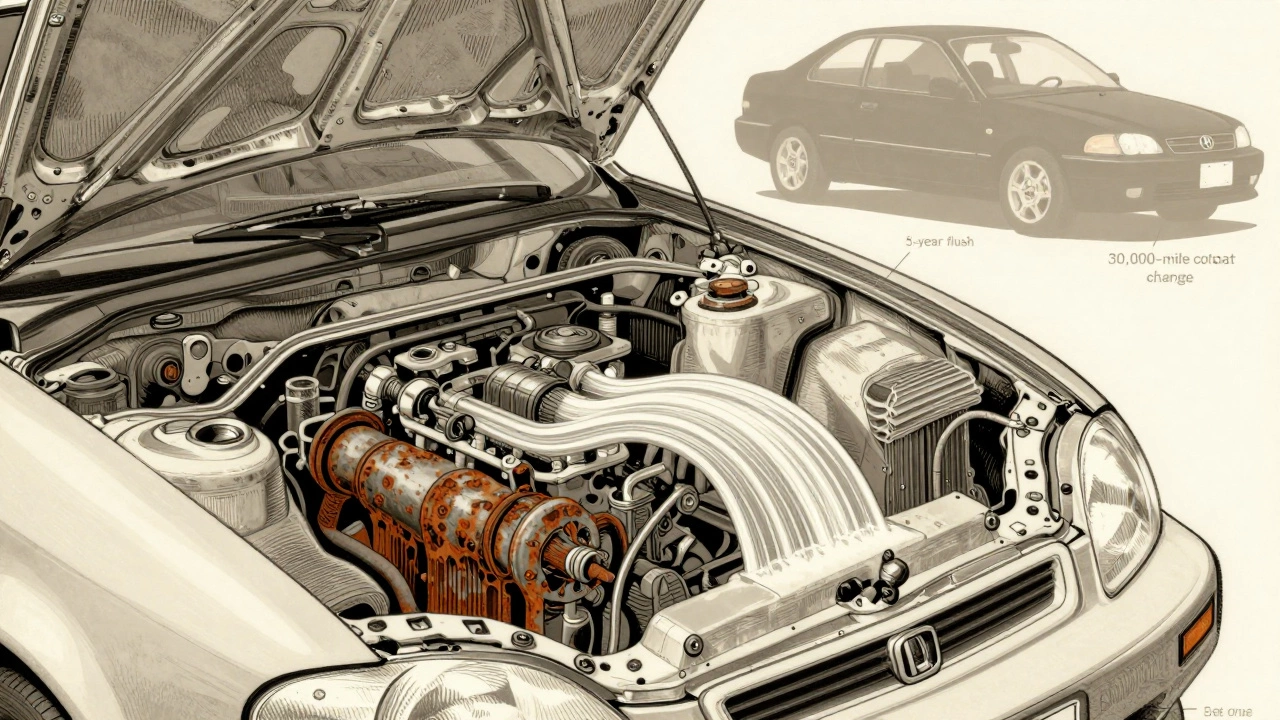
A radiator isn’t just a metal box with tubes. It’s a precision cooling system made of aluminum, copper, brass, plastic end tanks, and rubber hoses. Each part wears differently. The metal core can corrode from old coolant, plastic tanks crack from heat cycles, and rubber hoses dry out and swell. A radiator doesn’t fail because it’s old - it fails because it was neglected.
Take a 2005 Ford Focus with 180,000 miles. The radiator still works because the owner changed the coolant every 30,000 miles and never let the engine overheat. Now compare that to a similar car where the coolant was never touched after 2010. By 2020, the internal passages were clogged with rust and scale. The plastic end tanks? Cracked from thermal stress. That radiator didn’t die of old age - it died of laziness.
Why Most Radiators Don’t Hit 20 Years
Modern radiators are lighter and cheaper than older ones. Aluminum cores replaced copper-brass because they’re easier to manufacture and cheaper to replace. But aluminum corrodes faster if coolant isn’t maintained. The plastic end tanks, designed to be lightweight, become brittle after 8-10 years of constant heating and cooling.
In the UK, where winters are damp and roads are salted in winter, corrosion is a silent killer. Salt gets trapped in the radiator fins, and if coolant is diluted or old, it turns acidic. That acidity eats away at the aluminum. A 2010 Nissan Qashqai with 150,000 miles in Manchester might have a radiator that’s 80% clogged with rust - even if it still looks fine from the outside.
Manufacturers design radiators to last 8-12 years under normal conditions. That’s not a guarantee - it’s a baseline. If you want to beat that, you need to work at it.
How to Make Your Radiator Last 20 Years
There’s no magic trick. But there are five simple habits that turn average radiators into decades-long performers.
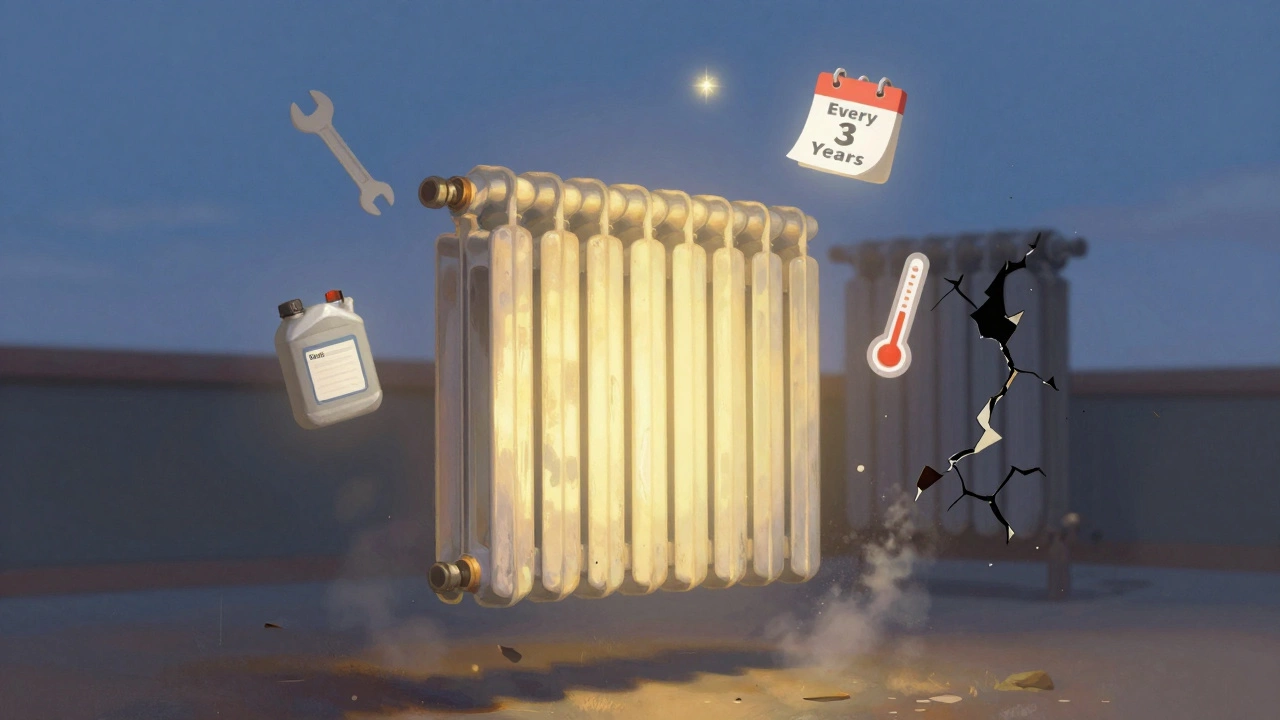
- Change coolant every 30,000-40,000 miles or every 3 years - even if the bottle says "lifetime fluid." That’s marketing, not engineering. Coolant breaks down. It loses its rust inhibitors. By year five, it’s just hot water with a hint of dye.
- Use the right coolant - not the cheapest one from the garage. Check your manual. Some cars need OAT (organic acid technology), others need hybrid or silicate-based formulas. Mixing them? You get sludge. Sludge = blocked tubes = overheating.
- Flush the system every 60,000 miles - don’t just top up. Flushing removes debris, scale, and metal particles that accumulate over time. A simple flush costs £40-£60. Replacing a radiator costs £300-£800.
- Watch the temperature gauge - if the needle creeps into the red, even once, your radiator is under stress. Overheating warps the core and cracks the tanks. Don’t ignore it. Pull over. Let it cool. Get it checked.
- Inspect hoses and clamps annually - a leaking hose puts pressure on the radiator. A loose clamp lets air in, causing hot spots. Air pockets = hot spots = cracked aluminum.
These steps aren’t about being obsessive. They’re about being smart. A radiator that lasts 20 years isn’t lucky - it’s maintained.
Signs Your Radiator Is Failing (Before It Leaves You Stranded)
You don’t need a mechanic to spot trouble. Look for these five red flags:
- Coolant puddles under the car - especially near the front. Green, orange, or pink fluid? That’s not oil. It’s coolant leaking from a crack, hose, or seal.
- Steam or smoke from the engine - not from the exhaust. From the radiator area. That’s overheating in real time.
- Sludge in the coolant reservoir - if your coolant looks like muddy soup, it’s full of rust and debris. Time for a flush - or worse, a replacement.
- Engine overheating, even after replacing the thermostat - if the thermostat is new and it still overheats, the radiator is likely clogged.
- High engine temperature with low cabin heat - if your heater blows cold air but the temp gauge is high, coolant isn’t circulating. That’s a blocked radiator.
These aren’t vague warnings. They’re clear signals. Act on them before you’re stuck on the M60 with a blown head gasket.
What About Aftermarket or Upgraded Radiators?
Some people buy upgraded radiators - thicker cores, dual fans, all-metal construction. They’re great for track cars or towing heavy loads. But for daily driving? Overkill.
A high-performance radiator won’t last longer if you still use old coolant or skip flushes. It might even cause problems if it’s too big for your car’s cooling system. Modern cars are tuned precisely. Bigger isn’t always better.
Stick with OEM-spec replacements unless you’re modifying the engine. A quality OEM radiator from a trusted supplier (like Valeo, Behr, or Denso) will outlast a cheap aftermarket one every time.
Real-World Examples: Radiators That Made It
In Manchester, I’ve seen three radiators that lasted over 20 years:
- A 1999 Volvo 850 with 240,000 miles - coolant changed every 3 years, never overheated, original radiator still in place.
- A 2001 Toyota Corolla with 210,000 miles - owner used only Toyota Long Life Coolant, flushed every 60k miles.
- A 1997 Honda Civic - driven by a retired mechanic who checked coolant levels every oil change. Still running in 2025.
What do they have in common? No magic. No expensive upgrades. Just consistent care.
When to Replace It - Even If It’s Not Leaking
Some people wait until the radiator bursts. That’s risky. If your car is 15+ years old and the radiator has never been flushed or replaced, it’s a ticking time bomb. Even if it’s not leaking now, the internal corrosion is likely eating away at the tubes.
At 15 years or 150,000 miles, start budgeting for a replacement. It’s not a question of if - it’s a question of when. A £400 radiator replacement now is cheaper than a £2,000 engine rebuild later.
And don’t assume a new radiator will fix overheating. If the water pump is failing or the thermostat is stuck, the new radiator will just die faster. Always check the whole cooling system when replacing the radiator.
Final Thought: It’s Not About Age - It’s About Care
A car radiator can last 20 years. But only if you treat it like part of the engine - not something you ignore until it breaks. The difference between a radiator that lasts and one that fails early isn’t luck. It’s routine. Coolant changes. Inspections. No overheating.
If you’ve kept your car this long, don’t let the radiator be the weak link. It’s not expensive to maintain. It just takes a little attention. And in the end, that’s what keeps older cars on the road - not expensive parts, but simple, consistent habits.
Can a radiator last 20 years without any maintenance?
No. Radiators that last 20 years are maintained. Without regular coolant changes, flushing, and leak checks, corrosion, clogs, and cracks will set in long before 20 years. Even the best-built radiators fail without proper care.
What coolant should I use for my car?
Always use the type specified in your owner’s manual. Most modern cars use OAT (organic acid technology) coolant, often orange, red, or pink. Older cars might need silicate-based coolant. Mixing types causes sludge. Don’t guess - check the manual or ask a mechanic with your VIN.
How often should I flush my radiator?
Every 60,000 miles or every 5 years, whichever comes first. Even if your coolant looks clean, the rust inhibitors wear out. A flush removes debris and restores protection. Skipping this is the #1 reason radiators fail early.
Is a plastic radiator worse than a metal one?
Not necessarily. Modern radiators use plastic end tanks because they’re cheaper and resist corrosion better than metal. But plastic becomes brittle over time. The core is still aluminum or copper-brass. The problem isn’t the material - it’s neglect. Heat cycles and old coolant damage plastic tanks faster than metal cores.
Should I replace my radiator if it’s not leaking yet?
If your car is over 15 years old or has over 150,000 miles, and you’ve never flushed the system, yes - consider replacing it preemptively. Internal corrosion can clog tubes without visible leaks. A blocked radiator causes overheating, which can destroy your engine. Replacing it before failure saves you from far more expensive repairs.