Suspension Comfort Calculator
Find out if upgrading your suspension is worth the investment based on your driving habits and budget.
Recommendation
Cost Analysis
Why This Recommendation
If you’ve ever bounced over a pothole like a pebble in a washing machine, you know suspension isn’t just about handling-it’s about comfort. The right suspension turns a jarring drive into something smooth, quiet, and almost floaty. But what actually gives the smoothest ride? It’s not just about springs or shocks. It’s about how the whole system talks to the road-and how well it listens.
Air Suspension: The Gold Standard for Comfort
Air suspension is the quiet king of ride smoothness. Instead of steel coils or leaf springs, it uses inflatable air bags made of durable rubber and fabric. These bags adjust their pressure in real time, so the car stays level whether you’re carrying one person or five with luggage.
Most luxury cars-Mercedes S-Class, BMW 7 Series, Audi A8-use air suspension because it absorbs bumps better than any mechanical system. When you hit a speed bump, the air bag compresses slowly, like a pillow full of air, then gently returns to shape. No metal-on-metal clunk. No harsh rebound.
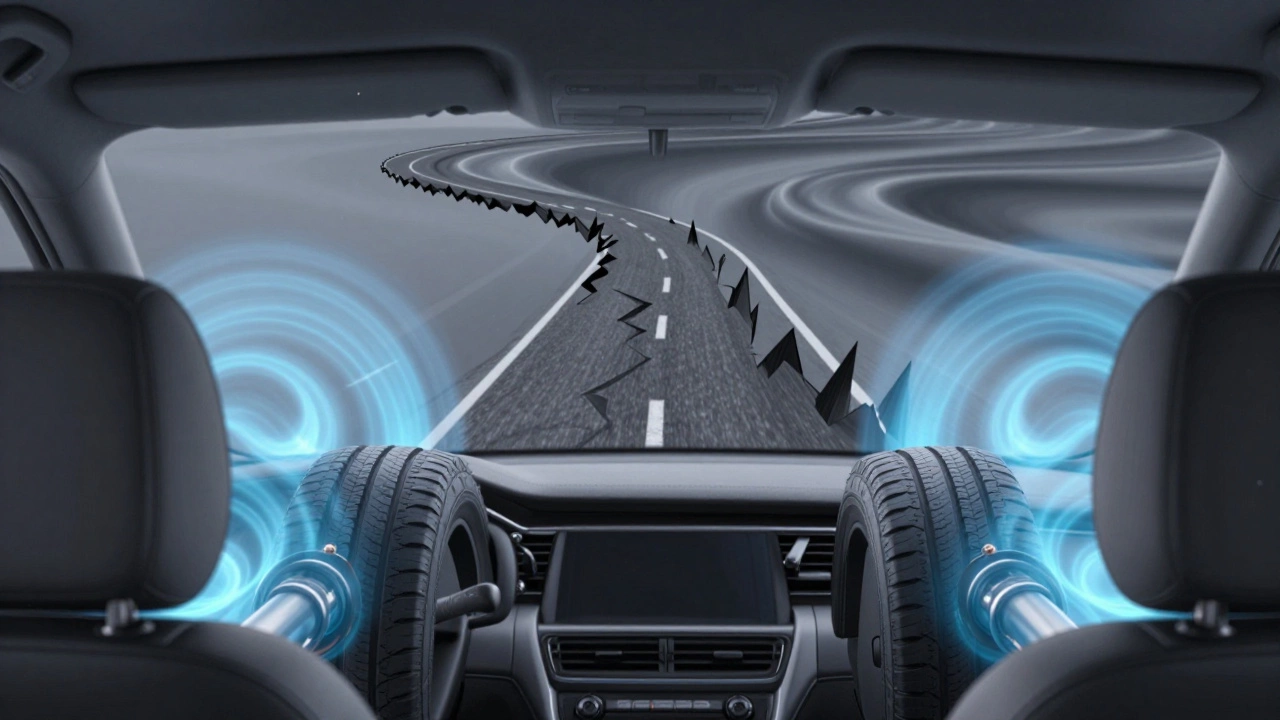
Modern air systems also work with sensors that read road conditions every 10 milliseconds. If the system detects a rough patch ahead, it softens the suspension before you even hit it. That’s not magic. It’s engineering. And it’s why people who switch from standard suspension to air often say, ‘I didn’t know my car could feel this good.’
Adaptive Dampers: Smart Shock Absorbers
Adaptive suspension doesn’t replace springs-it upgrades the shocks. Traditional shocks have fixed damping rates: stiff for sport, soft for comfort. Adaptive shocks change their resistance on the fly using electric valves or magnetorheological fluid.
That fluid? It’s oil mixed with tiny iron particles. When an electric current passes through, the particles align and thicken the fluid instantly. Turn up the current, and the shock stiffens. Turn it down, and it flows like water. Systems like BMW’s Adaptive M Suspension or Cadillac’s Magnetic Ride Control do this 1,000 times per second.
On a smooth highway, the suspension stays soft for comfort. Hit a patch of broken asphalt? The system firms up in milliseconds to keep the body steady. It’s not as plush as air suspension, but it’s the best balance of comfort and control you’ll find in non-luxury cars.
Coilover Suspension: Not for Comfort
Coilovers are popular in performance circles, but they’re the opposite of smooth. These are adjustable spring-and-shock combos built for lowering ride height and stiffening response. Even on their softest setting, they’re firmer than factory suspensions.
Why do people use them? For cornering grip, not comfort. If you’re chasing lap times on a track, coilovers are great. If you’re commuting through Manchester’s pothole-riddled roads, they’ll rattle your fillings loose. Skip coilovers if your goal is a quiet, floaty ride.

Hydraulic and Passive Suspensions: The Basics
Most economy and mid-range cars still use passive suspension: fixed springs and dampers tuned for a middle ground between comfort and control. These work fine for daily driving, but they can’t adapt. A bump that feels soft when the car’s empty becomes a jolt when you’re full of passengers.
Some older luxury cars used hydraulic systems like Citroën’s famous Hydractive suspension. These used pressurized fluid to cushion bumps. They were incredibly smooth-but expensive to fix. Today, only a few niche brands still use them. If you find one, keep it running. They’re rare for a reason.
What About Tires and Wheels?
Even the best suspension can’t fix bad tires. Large-diameter wheels with low-profile tires (like 19-inch rims with 35-series sidewalls) transmit more road noise and vibration. They look aggressive, but they kill ride quality.
For maximum smoothness, go smaller. A 17-inch wheel with a 50-series tire gives the sidewall more room to flex and absorb impacts. Pair that with quality touring tires like the Michelin Primacy 4 or Continental PremiumContact 6, and you’ll notice a huge difference-even with a basic suspension.
Real-World Test: What Feels Best?
Let’s say you drive a 2023 Honda Accord with standard suspension. It’s decent, but you feel every crack in the road. Now swap in air suspension-like the aftermarket kits from Air Lift or KW Variant 3. Suddenly, your commute feels like gliding.
Or take a 2024 Toyota Camry with adaptive dampers. It’s not as soft as a Mercedes, but it’s noticeably smoother than a Ford Fusion with passive suspension. The difference isn’t subtle-it’s the kind of thing you notice after just one block.
Test it yourself: drive the same route in two cars-one with air or adaptive suspension, one without. Pay attention to how your shoulders feel after 20 minutes. If you’re tense, the suspension isn’t doing its job.
Cost vs. Comfort: Is It Worth It?
A factory air suspension system adds $2,000 to $5,000 to a car’s price. Aftermarket kits cost $1,500-$3,500 to install. Adaptive dampers are cheaper-often included in mid-tier trims for under $1,000 extra.
Here’s the truth: if you drive on rough roads daily, live in a city with bad infrastructure, or just hate feeling every bump, the investment pays off. People who’ve made the switch rarely go back. The comfort isn’t just nice-it becomes a necessity.
On the flip side, if you mostly drive on smooth highways and rarely carry passengers, a good set of touring tires and OEM shocks will do fine. You don’t need air suspension to be comfortable. But if you want the smoothest possible ride? There’s no better option.
Final Thought: It’s About the Whole System
There’s no single part that makes a ride smooth. It’s the combo: air bags or adaptive dampers, the right tire profile, properly aligned geometry, and well-maintained bushings. A worn control arm or cracked mount can ruin even the best suspension.
Check your suspension regularly. If your car leans to one side, bounces after a bump, or makes clunking noises over speed bumps, something’s worn out. Fix it before you spend money on an upgrade. A healthy system is the foundation.
The smoothest ride isn’t about spending the most. It’s about matching the right technology to your driving life. For most people, adaptive suspension offers the best value. For those who want perfection? Air suspension still holds the crown.
Is air suspension worth the cost?
Yes, if you drive on rough roads, carry heavy loads often, or value quiet comfort over sporty handling. Air suspension reduces fatigue on long drives and protects your car’s components from constant jarring. But if you mostly drive on smooth highways and don’t mind a firmer ride, it’s not necessary. Maintenance costs are higher, so factor that in.
Can I add air suspension to any car?
Most cars can be retrofitted with aftermarket air suspension kits, but it’s not a simple swap. It requires mounting air bags, installing compressors, adding control modules, and rerouting brake lines. Professional installation is recommended. It works best on older luxury cars or trucks, but modern sedans can also be fitted with custom kits from brands like Air Lift or Ridetech.
Do adaptive suspensions wear out faster?
Not necessarily. Adaptive dampers have more electronics, so sensors or valves can fail-but the shock bodies themselves last just as long as regular ones. Most last 80,000-100,000 miles. The main issue is cost: replacing a single adaptive shock can run $800-$1,200. Regular shocks cost $150-$300 each. Budget for repairs if you go adaptive.
Does tire pressure affect ride smoothness?
Absolutely. Overinflated tires make the ride harsher because they can’t absorb impacts. Underinflated tires hurt fuel economy and handling. For the smoothest ride, stick to the manufacturer’s recommended pressure-usually found on the driver’s door jamb. Many people inflate tires too high thinking it helps longevity, but it actually makes the ride worse.
What’s the difference between air suspension and self-leveling suspension?
Self-leveling keeps the car at a set height regardless of load, but it doesn’t change firmness. Air suspension does both. Most modern self-leveling systems use air bags anyway, so the terms often overlap. But true air suspension lets you adjust ride height and stiffness manually or automatically. Self-leveling just keeps the car level.