
Spark Plug Fuel Savings Calculator
Worn spark plugs can reduce fuel efficiency by 10-15%. Calculate how much you could save annually by replacing your spark plugs.
Your Current Fuel Data
Your Potential Savings
Your vehicle could improve fuel efficiency by 12.5% (average of 10-15% range) with new spark plugs.
Important: This is an estimate based on the average 12.5% efficiency gain. Actual savings may vary based on driving conditions and vehicle type.
Ignoring regular maintenance of spark plugs can lead to serious issues. These small parts pack a big punch-when they fail, your engine's performance suffers, fuel economy drops, and costly damage can follow.
Engine Performance Takes a Hit
When spark plugs wear out, they can't create the strong spark needed to ignite the air-fuel mixture in your engine's combustion chamber. You'll notice your car shaking when idling, hesitation during acceleration, or even sudden stalling. Imagine driving on a rainy Manchester morning and your engine sputters as you try to merge onto the highway. That's not just annoying-it's dangerous. A single misfire can reduce engine power by up to 25%, making your car feel sluggish and unresponsive. The Society of Automotive Engineers confirms that misfires directly impact throttle response and overall drivability.
Fuel Efficiency Drops Significantly
Worn spark plugs cause incomplete combustion, meaning not all the fuel burns properly. This forces your engine to work harder for less power. If your car normally gets 35 miles per gallon, worn spark plugs could drop that to 30 MPG or lower. Over a year, that's hundreds of pounds extra on fuel costs. In fact, the UK's Driver and Vehicle Standards Agency (DVSA) reports that faulty spark plugs can reduce fuel efficiency by 10-15% on average. That means paying £100-£150 more annually for the same mileage. Simple math: skip this £30 spark plug replacement, and you'll spend far more on gas.
Emissions Rise and Damage the Catalytic Converter
Unburned fuel from misfiring spark plugs flows into your exhaust system. This overloads the catalytic converter, which is designed to clean emissions. When it can't keep up, toxic gases like carbon monoxide escape into the air. More critically, the converter overheats trying to burn off excess fuel. A damaged catalytic converter costs £800-£2,500 to replace in the UK-far more than spark plugs. The DVSA also warns that failing catalytic converters can cause your car to fail its MOT test due to excessive emissions. One study from the Institute of Mechanical Engineers shows that 30% of catalytic converter failures trace back to neglected spark plugs.

Starting Problems and Engine Misfires
Cold mornings are the worst for worn spark plugs. If they're weak or covered in carbon deposits, they might not spark at all. You'll hear a clicking noise when turning the key, or the engine might crank but refuse to start. In extreme cases, moisture or condensation in the ignition system can cause complete failure. Picture this: you're late for work, and your car won't start because a single spark plug failed. That's not a coincidence-it's a direct result of skipping replacements. The ignition system relies on all spark plugs working in sync. When one fails, the others compensate, accelerating wear across the board.
Costly Repairs Down the Line
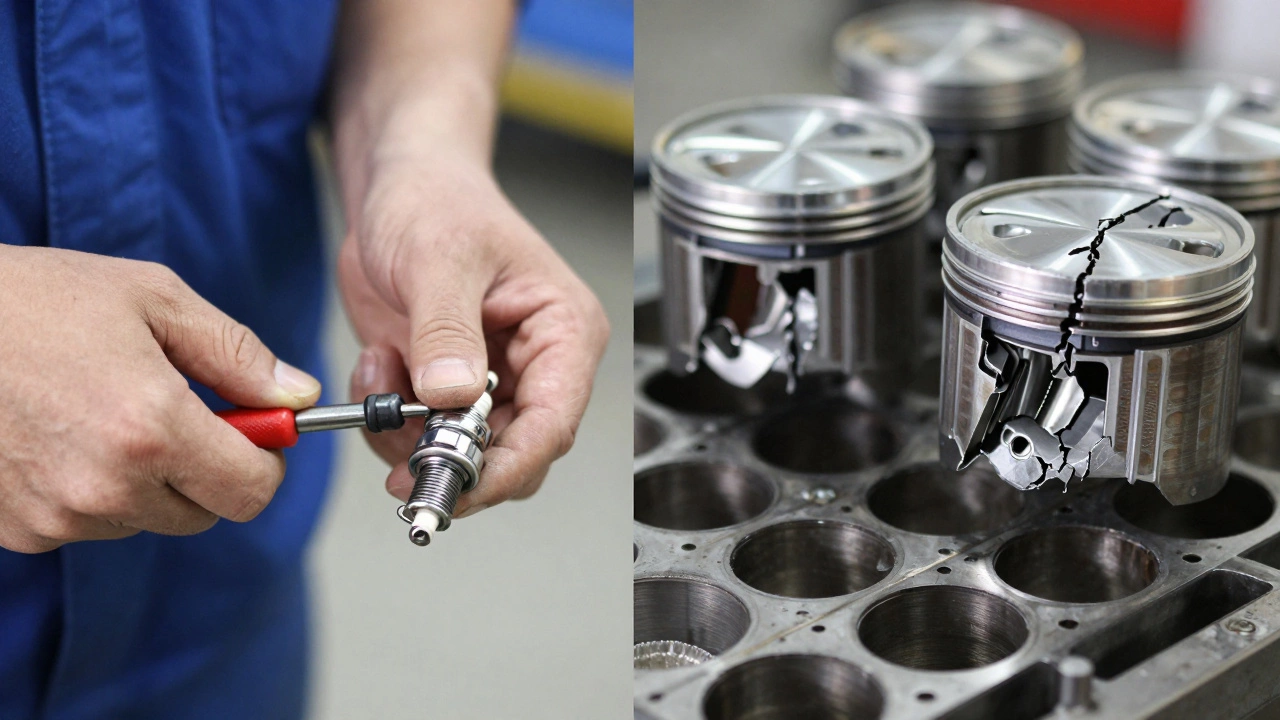
Ignoring spark plug issues doesn't just affect immediate performance. It triggers a chain reaction of damage. Misfires can warp engine valves, damage cylinder walls, or even crack pistons. Repairing these problems costs £1,500-£5,000. Meanwhile, a full spark plug replacement typically costs £50-£150. That's a 30x difference in cost for the same job. Mechanics in Manchester see this regularly-drivers who delay replacements end up with engine rebuilds they could have avoided. The key takeaway? Spark plug maintenance is cheap insurance against catastrophic failure.
How Often Should You Replace Spark Plugs?
Most manufacturers recommend replacing spark plugs every 30,000-100,000 miles, depending on the type. Standard copper plugs need changing every 30,000 miles, while platinum or iridium ones last up to 100,000 miles. Check your owner's manual for exact intervals. Don't wait for symptoms to appear-by then, damage may already be done. A good rule of thumb: replace them when you change your engine oil every 6 months or 6,000 miles. It's a small task that prevents major headaches later.
Real-World Example: A Manchester Driver's Story
James, a delivery driver from Manchester, ignored his spark plug warning light for months. His car started misfiring during heavy rain, causing delivery delays. Eventually, it wouldn't start at all. He paid £1,200 to replace a damaged catalytic converter and £800 for new spark plugs. Had he replaced them at the recommended 60,000-mile interval (costing £120), he'd have saved over £1,800. "I thought it was a minor issue," he said. "Now I know better."
How do I know if my spark plugs need replacing?
Look for these signs: rough idling, poor acceleration, frequent stalling, or the check engine light turning on. Your car might also feel sluggish or vibrate excessively. If you notice any of these, get your spark plugs checked immediately. A mechanic can inspect them in minutes-no need for guesswork.
Can I drive with a bad spark plug?
Technically yes, but you shouldn't. Driving with a faulty spark plug risks further engine damage. It can overheat the catalytic converter, cause misfires that strain other components, and even lead to complete engine failure. Short trips might be okay, but avoid long drives. Get it fixed as soon as possible to avoid bigger costs.
Do I need to replace all spark plugs at once?
Absolutely. Spark plugs wear evenly over time. Replacing just one or two creates imbalance in the ignition system, leading to uneven performance and faster wear on the remaining plugs. Mechanics always replace all spark plugs together to ensure smooth operation. It's a small extra cost for better long-term reliability.
What happens if I use the wrong spark plug type?
Using incorrect spark plugs can cause serious issues. Wrong heat ranges may overheat or foul the plugs, while mismatched thread sizes can damage cylinder heads. Always match the manufacturer's specifications. For example, a BMW 3 Series requires specific iridium plugs-using standard copper ones would lead to premature failure. Check your manual or ask a mechanic for the right type.
Can spark plugs cause a car to fail its MOT?
Yes. Faulty spark plugs increase emissions, which is a key MOT test item. If your car emits excessive carbon monoxide or hydrocarbons due to misfires, it will fail. The DVSA reports that 12% of MOT failures in 2025 were linked to ignition system issues, including worn spark plugs. Replacing them before your MOT is a smart move to avoid retest fees and delays.