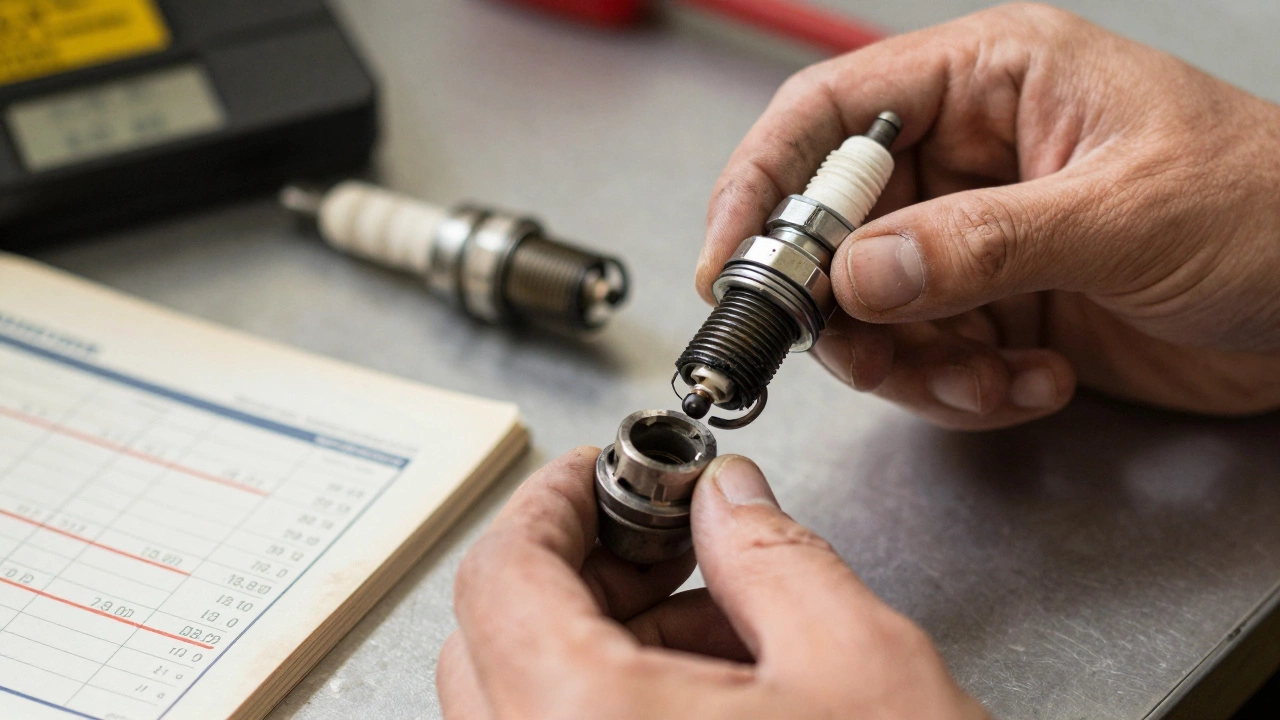
Spark Plug Replacement Calculator
Most car owners don’t think about spark plugs until the engine starts misfiring or refuses to start. But spark plugs are one of the most critical parts in your engine-they ignite the fuel-air mixture that powers your car. If they fail, your engine doesn’t run. So how often do spark plugs need changing? The answer isn’t one-size-fits-all. It depends on your car, the type of plugs, and how you drive.
General Spark Plug Replacement Intervals
Most manufacturers recommend replacing spark plugs every 30,000 to 100,000 miles. That’s a huge range, and it’s not arbitrary. Older cars with standard copper spark plugs usually need new ones around every 30,000 to 40,000 miles. Newer cars, especially those made after 2010, often come with long-life plugs like platinum or iridium that can last up to 100,000 miles.
For example, a 2018 Honda Civic with factory-installed iridium plugs is designed to go 100,000 miles before replacement. But a 2005 Ford Focus with copper plugs might need new ones by 40,000 miles. Always check your owner’s manual. It’s the only source that knows your car’s exact specs.
Types of Spark Plugs and Their Lifespans
Not all spark plugs are made the same. The material used in the electrode affects how long they last:
- Copper: The oldest and cheapest type. Lasts 20,000 to 30,000 miles. Good for older engines but wears out fast.
- Platinum: More durable than copper. Lasts 60,000 to 100,000 miles. Common in mid-2000s to early 2010s vehicles.
- Iridium: The most durable. Can last 80,000 to 120,000 miles. Found in most modern cars. Handles high heat and pressure better than other types.
Iridium plugs are now the standard in new vehicles because they provide better fuel efficiency and more consistent ignition. But they cost more-sometimes $10 to $20 each. Still, replacing them less often means fewer trips to the mechanic.
Signs Your Spark Plugs Are Worn Out
You don’t have to wait for the odometer to hit the magic number. Spark plugs fail before their time if you drive under harsh conditions. Watch for these warning signs:
- Engine misfires: You feel a jerking or stumbling sensation when accelerating. The check engine light may flash.
- Hard starting: The car takes longer than usual to turn over, especially in cold weather.
- Reduced fuel economy: You’re filling up more often without changing your driving habits.
- Slow acceleration: The car feels sluggish when you press the gas pedal.
- Unusual engine noise: Rough idling, knocking, or ticking sounds coming from the engine bay.
One real-world example: A 2017 Toyota Camry owner noticed their fuel economy dropped from 32 mpg to 26 mpg over six months. After checking the plugs, they found iridium electrodes coated in carbon buildup. Replacing them restored fuel efficiency and smoothed out the idle.

Driving Conditions That Shorten Spark Plug Life
Even if your car’s manual says 100,000 miles, real-world driving can cut that in half. Here’s what wears them out faster:
- Short trips: If you mostly drive under 5 miles at a time, the engine doesn’t reach full operating temperature. That causes fuel residue to build up on the plugs.
- Stop-and-go traffic: Constant idling and low-speed driving increases carbon deposits.
- Low-quality fuel: Fuels with too many additives or contaminants can foul plugs faster.
- Overheating engines: If your cooling system is failing, the plugs run hotter than designed, leading to early wear.
City drivers who commute in heavy traffic might need to replace plugs every 50,000 miles-even if the manual says 100,000. Highway drivers who take long trips rarely see issues until the full interval.
What Happens If You Don’t Change Them?
Ignoring worn spark plugs doesn’t just hurt performance-it can damage your engine. Here’s what can go wrong:
- Unburned fuel enters the exhaust: This can overheat and crack the catalytic converter, a repair that costs $1,000 to $2,500.
- Engine misfires cause oil contamination: Unburned fuel washes oil off cylinder walls, leading to increased wear on pistons and rings.
- Increased emissions: Your car will fail emissions tests, which could be required for registration in many states.
- Complete engine failure: In rare cases, misfires can cause piston damage or even bent valves if timing is thrown off.
One mechanic in Ohio reported replacing a catalytic converter on a 2015 Hyundai Sonata that had gone 140,000 miles without plug changes. The owner thought the car was fine because it still ran. But the converter was coated in soot and needed replacing-costing nearly three times what new spark plugs would have.
How to Check Spark Plugs Yourself
You don’t need a shop to check them. With a spark plug socket and a little patience, you can inspect them in under an hour.
- Turn off the engine and let it cool. Hot engines can warp metal parts.
- Remove the ignition coils or wires from each plug.
- Use a spark plug socket to carefully unscrew each plug.
- Look at the electrode tip:
- Light brown or gray: Perfect condition.
- Black, sooty deposits: Rich fuel mixture or oil leak.
- White or blistered: Engine overheating or wrong plug heat range.
- Worn electrodes or gap too wide: Time for replacement.
Use a gap gauge to check the distance between the center and ground electrode. Most modern plugs need a gap between 0.028 and 0.060 inches. If it’s wider than recommended, the spark is weaker and ignition suffers.

When to Replace vs. Clean
Some people try to clean old spark plugs with sandpaper or a wire brush. Don’t do it. Modern plugs are precision-engineered. Cleaning them rarely restores performance and can damage the ceramic insulator or electrode coating.
Only clean plugs if they’re lightly fouled and you’re in a pinch-like during a road trip. Even then, replace them as soon as possible. A cleaned plug might last another 5,000 miles, but it’s not a long-term fix.
Professional Replacement Costs
Replacing spark plugs yourself can save $150 to $300 in labor. Here’s what you’ll pay:
- Parts only: $15 to $80 for a full set, depending on plug type.
- Professional labor: $100 to $250, depending on engine access. Some cars (like BMWs or Subarus) have tight engine bays, making the job longer and more expensive.
- Total cost: $120 to $330 for a full replacement.
For most drivers, doing it yourself is worth the effort. It’s not complicated, and you’ll know exactly what condition your plugs were in.
Best Practice: Stick to the Schedule, But Stay Alert
The best advice? Follow your owner’s manual-but keep an eye out for symptoms. If you drive mostly short trips in cold weather, consider replacing plugs at 60,000 miles even if the manual says 100,000. If you notice any of the warning signs, don’t wait. A $50 set of plugs can prevent a $2,000 catalytic converter repair.
Spark plugs are cheap insurance. They’re not glamorous, but they’re essential. Replace them on time, and your engine will run smoother, cleaner, and longer.
How long do spark plugs last in years, not miles?
Spark plugs typically last 5 to 10 years, depending on mileage and driving habits. If you drive less than 10,000 miles a year, your iridium plugs could last 10 years or more. But if you drive mostly short trips or in stop-and-go traffic, even new plugs may need replacing after 5 years due to carbon buildup.
Can I use any spark plug in my car?
No. Spark plugs vary in thread size, reach, heat range, and electrode material. Using the wrong type can cause engine damage. Always match the part number in your owner’s manual or use a plug that’s listed as a direct replacement by the manufacturer. Aftermarket plugs that claim "universal fit" often don’t meet OEM specs.
Do I need to replace all spark plugs at once?
Yes. Even if only one plug looks bad, the others are likely close to the same wear level. Replacing just one can create uneven firing, leading to misfires and poor performance. Always replace the full set to keep engine performance balanced.
Why do some cars have spark plug replacement intervals over 100,000 miles?
Modern engines use high-quality iridium or platinum plugs, better fuel injection systems, and tighter engine tolerances. These improvements reduce carbon buildup and electrode wear. Also, manufacturers design these engines to run cleaner and more efficiently, extending plug life. But this doesn’t mean you can ignore them-ignition system issues can still arise.
Can bad spark plugs cause the check engine light to come on?
Yes. A misfire caused by worn or fouled spark plugs triggers the check engine light, often with codes like P0300 (random misfire) or P0301 through P0308 (cylinder-specific misfires). The light may blink if misfires are severe, which can damage the catalytic converter. Don’t ignore it.