Engine Oil Condition Checker
Check your engine oil condition with this simple tool. Answer the questions below based on your dipstick test and paper towel test results to see if your oil needs changing.
Oil Color
Texture
Smell
Oil Level
Paper Towel Test
Your oil is performing well. Continue monitoring your oil condition every 2-3 weeks.
It's time to schedule an oil change soon. Consider changing your oil within the next 500 miles.
Your engine oil is no longer providing adequate protection. Change your oil as soon as possible to prevent engine damage.
Ever opened your hood and stared at the dipstick, wondering if that dark, gritty stuff is still doing its job-or if it’s time to panic? You’re not alone. Many drivers wait until the dashboard light flashes or the engine starts knocking, but by then, it’s often too late. The truth is, engine oil doesn’t just wear out from mileage. It breaks down from heat, contamination, and time. And if you’re driving in the UK’s damp, stop-start traffic, your oil is under more stress than you think.
What Engine Oil Actually Does
Engine oil isn’t just a lubricant. It’s your engine’s life support system. It cools hot parts like pistons and valves, cleans away tiny metal shavings and carbon deposits, seals gaps between piston rings and cylinder walls, and prevents rust by coating metal surfaces. When oil loses its ability to do any of these things, your engine starts taking damage-slowly, quietly, and expensively.
Modern synthetic oils last longer than old-school mineral oils, but they still degrade. A 5W-30 synthetic might claim 10,000 miles, but if you’re doing short trips in Manchester rain, that number drops fast. Every time you start the engine cold, moisture builds up. It doesn’t evaporate unless the engine runs hot for at least 20 minutes. That water mixes with oil, creating sludge. Sludge clogs oil passages. And once that happens, your bearings, turbocharger, or camshaft can seize.
Visual Check: The Dipstick Test
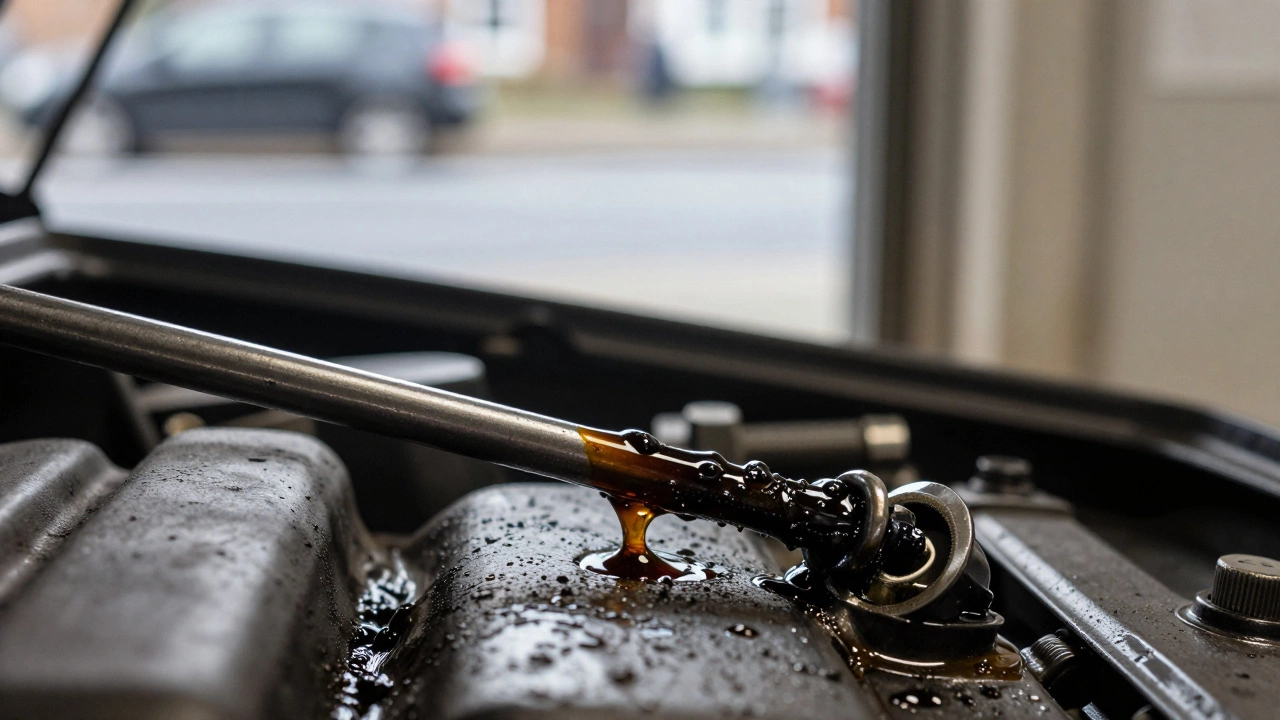
The easiest way to check your oil is right at the dipstick. Do this when the engine is cold and the car is on level ground. Pull out the stick, wipe it clean, reinsert it fully, then pull it out again.
- Colour: Fresh oil is amber or light brown. If it’s black, that doesn’t automatically mean it’s bad-synthetic oils darken quickly as they clean the engine. But if it’s thick black, like motor tar, that’s a red flag.
- Texture: Rub a drop between your fingers. It should feel slick. If it’s gritty, like sandpaper, there’s metal particles or dirt in there. That’s wear debris. Don’t ignore it.
- Smell: Fresh oil has a faint petroleum smell. If it smells burnt, like old frying oil, the oil has overheated. This often means your engine is running too hot or you’ve been pushing it too hard.
- Level: If it’s below the minimum mark, you’re running low. But if it’s over the max, you might have coolant leaking into the oil. That’s a head gasket problem.
One thing to watch for: if the oil looks milky or has a frothy texture, that’s coolant mixing in. That’s serious. Stop driving immediately and get it checked.
The Paper Towel Test
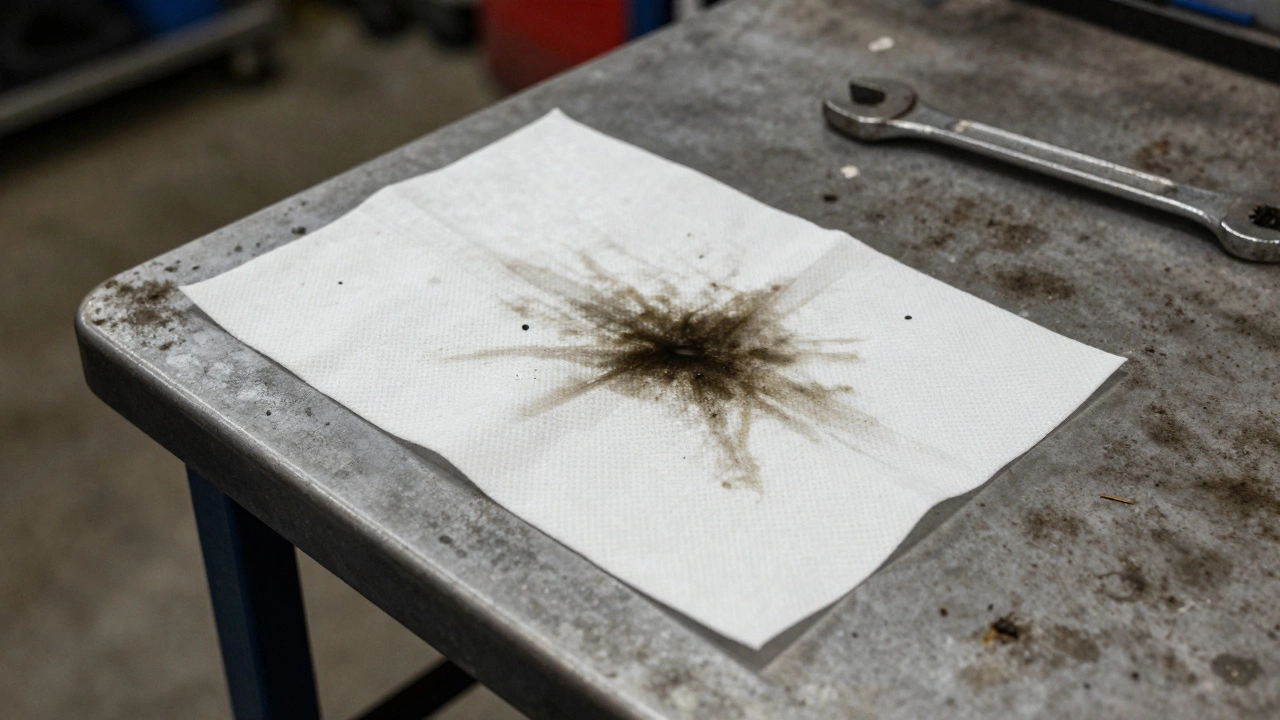
Here’s a trick mechanics use that doesn’t need any tools. Take a clean paper towel and dab a small drop of oil from the dipstick. Let it sit for a minute.
- If the oil spreads evenly with a light ring around the edge, it’s still in decent shape. The light ring means the oil has good detergents to keep contaminants suspended.
- If the oil forms a dark, thick center with little spread and a lot of dark particles stuck in the middle, the oil is done. The detergents have burned out, and the dirt is settling.
- If you see a sharp, dark ring with a clear outer edge, that’s a sign of fuel dilution. Fuel has thinned the oil. This happens if your engine runs rich, or if you’re doing a lot of short trips without letting it warm up fully.
This test doesn’t tell you the exact mileage left, but it tells you if the oil has lost its ability to protect. If the paper towel looks like a mud pie, it’s time to change it.
Oil Life Monitors: Are They Reliable?
Most cars made after 2010 have an oil life monitor. It tracks engine temperature, RPM, driving time, and sometimes even oil quality sensors. It’s convenient-but don’t treat it like gospel.
These systems assume you drive like a test driver: long highway miles, steady speeds, no traffic jams. If you’re doing 80% of your driving in town, in the rain, with the heater on full, your oil is aging faster than the monitor thinks. I’ve seen cars with 70% oil life left that had sludge clogging the oil pickup screen.
Use the monitor as a guide, not a rule. If it says you’ve got 30% left but your oil looks gritty and smells burnt, change it anyway. Better to spend £45 on an oil change than £2,000 on a rebuilt engine.
Time vs. Mileage: Which Matters More?
Most manufacturers say change oil every 10,000 miles or 12 months. But here’s the catch: if you drive 5,000 miles a year, you’re still changing oil every year. Why? Because oil oxidizes over time, even if the car sits in the garage.
Moisture builds up. Additives break down. The oil loses its anti-wear properties. A car that’s driven weekly and warmed up properly will keep oil in better shape than one that’s only started once a month. So if you’re not driving much, change the oil at least once a year. Don’t wait for the monitor to blink.
And if you’re using the car for towing, track days, or off-roading? Change it every 5,000 miles. That’s not a suggestion-it’s insurance.
What Happens If You Skip the Change?
Skipping oil changes doesn’t cause instant failure. It’s a slow death.
First, the oil loses viscosity. It gets thinner and can’t form a proper film between moving parts. Metal starts grinding on metal. Then, sludge builds up in the oil passages. The oil pump can’t push enough through. Bearings overheat. Valves stick. Turbochargers starve for lubrication.
By the time you hear knocking or see smoke from the exhaust, the damage is already done. Replacing a turbo on a modern diesel? £1,200. A full engine rebuild? £3,000+. An oil change? £50.
And it’s not just the engine. Old oil can clog the oil filter, which then bypasses and lets dirt straight into the engine. It can also cause the variable valve timing system to fail. That’s another £800 repair.
How to Choose the Right Oil
Not all oils are the same. Check your owner’s manual for the exact viscosity (like 5W-30 or 0W-20) and specification (like API SP or ACEA C3). Using the wrong oil can void your warranty or cause premature wear.
For UK driving conditions-cold winters, damp roads, urban stop-starts-go for a full synthetic. It handles temperature swings better and resists sludge longer. Avoid cheap mineral oils. They break down faster and don’t protect as well.
Brands like Mobil 1, Castrol EDGE, or Shell Helix Ultra are widely available and meet the latest standards. Don’t pay extra for “high mileage” oil unless your engine is over 75,000 miles and already burning oil. Those additives are for sealing leaks, not improving performance.
When to Change It: A Simple Rule
Here’s the practical, no-nonsense rule I follow for most UK drivers:
- If you drive under 10,000 miles a year → change every 12 months.
- If you drive over 10,000 miles a year → change every 7,500 miles.
- If you do short trips (under 5 miles), drive in heavy traffic, or tow → change every 5,000 miles.
- If the oil looks black, gritty, smells burnt, or feels thick → change it now, regardless of mileage.
That’s it. No apps, no guesswork. Just check the dipstick every few weeks. If it looks clean and smells fine, you’re good. If not, don’t wait for a light to come on.
What to Do If You’re Not Sure
If you’re still unsure, take a small sample to a trusted garage. Most will put a drop on a test strip and give you a free reading. It tells you viscosity, contamination level, and additive depletion. It costs nothing and saves you from expensive mistakes.
Or, if you’re the DIY type, buy an oil analysis kit online. Companies like Blackstone Labs send you a kit, you send them a sample, and they email you a detailed report. It’s £35, but you’ll know exactly what’s in your oil-and whether your engine is quietly dying.
Don’t treat your engine like a black box. Oil is the first warning system. Learn to read it. Check it. Trust your eyes more than your dashboard.
Can I just top up my oil instead of changing it?
No. Topping up oil doesn’t fix degraded oil. If your oil is dirty, old, or contaminated, adding more just dilutes the problem. The sludge, metal particles, and broken-down additives are still there. You’re not restoring protection-you’re just making more of it. Always do a full change when the oil is past its life.
How often should I check my oil level?
Check it every time you fill up with fuel. That’s about every 2-3 weeks for most drivers. If you notice you’re topping up more than a quarter of a litre between changes, you might have a leak or burning oil-both need attention.
Does synthetic oil last longer than conventional oil?
Yes. Synthetic oil is engineered to resist heat and oxidation better than conventional oil. It maintains its viscosity longer and resists sludge formation. That’s why most modern cars require synthetic oil. It doesn’t mean you can go 20,000 miles without a change-just that you can safely go further than with mineral oil under the same conditions.
Is it okay to change oil before the recommended interval?
Absolutely. Changing oil early won’t harm your engine. In fact, if you drive in harsh conditions-cold weather, dusty roads, frequent short trips-it’s smart to change it sooner. Better safe than sorry. Many mechanics recommend changing oil at 5,000-6,000 miles for UK drivers, even if the manual says 10,000.
Can old oil cause the engine to overheat?
Yes. Oil helps cool engine parts, especially the pistons and turbocharger. When oil breaks down, it loses its ability to transfer heat. That can cause hot spots, leading to pre-ignition, detonation, or even a seized piston. If your engine runs hotter than normal and your oil is dark and thick, change it immediately.