Engine Oil Selector
Select Your Vehicle
Why This Matters
Choosing the right oil protects your engine, improves fuel economy, and prevents costly damage. The wrong oil can cause engine wear, reduced performance, and voided warranties.
Check your owner's manual for exact specifications. This tool provides general guidelines based on vehicle type and year.
Your Oil Recommendation
Select your vehicle type and year to see your specific recommendation.
Choosing the right engine oil isn’t about guessing or following what your buddy uses. It’s about matching your car’s needs exactly - and getting it wrong can cost you serious money. If you’ve ever stared at a shelf of oil bottles wondering which one actually fits your engine, you’re not alone. The answer isn’t hidden in marketing jargon. It’s in your owner’s manual, under your hood, and in the numbers stamped on the bottle.
Start With Your Owner’s Manual
Your car’s owner’s manual is the only document that knows your engine better than you do. Look for the section labeled “Lubrication,” “Maintenance,” or “Engine Oil.” You’ll find two critical details: the viscosity grade (like 5W-30 or 10W-40) and the API service rating (like SN, SP, or CK-4). These aren’t suggestions - they’re requirements.
For example, a 2023 Honda Civic needs API SP 5W-20. A 2021 Ford F-150 with a 3.5L EcoBoost demands API SP 5W-30. Use anything else, and you risk reduced fuel economy, increased wear, or even engine damage. Manufacturers test their engines with specific oils. They don’t leave this to chance.
Understand Viscosity: The Numbers That Matter
Engine oil viscosity tells you how thick or thin the oil flows at different temperatures. The number before the W (like 5W) shows how well it flows in cold weather. The number after (like 30) shows how thick it stays when hot.
Here’s the simple truth: if your oil is too thick when cold, your engine won’t get lubricated fast enough at startup - that’s when most wear happens. If it’s too thin when hot, metal parts start grinding together. That’s why viscosity matters more than brand.
Most modern cars use 0W-20, 5W-30, or 5W-20. Older cars (pre-2000) often need 10W-40. Diesel trucks? They often use 15W-40. Don’t switch to a thicker oil just because you think “it’s better.” Modern engines are built tight. Thicker oil doesn’t mean better protection - it means more resistance, less power, and lower fuel economy.
Check the API and ILSAC Ratings
Look for the donut-shaped symbol on the oil bottle. Inside it, you’ll see two codes:
- API Service Rating - like SN, SP, CK-4. SP is the latest for gasoline engines as of 2026. If your manual says SP, don’t use SN - it’s outdated.
- ILSAC Rating - like GF-6A or GF-6B. This is the fuel economy and emissions standard. GF-6A is now the norm for most passenger cars.
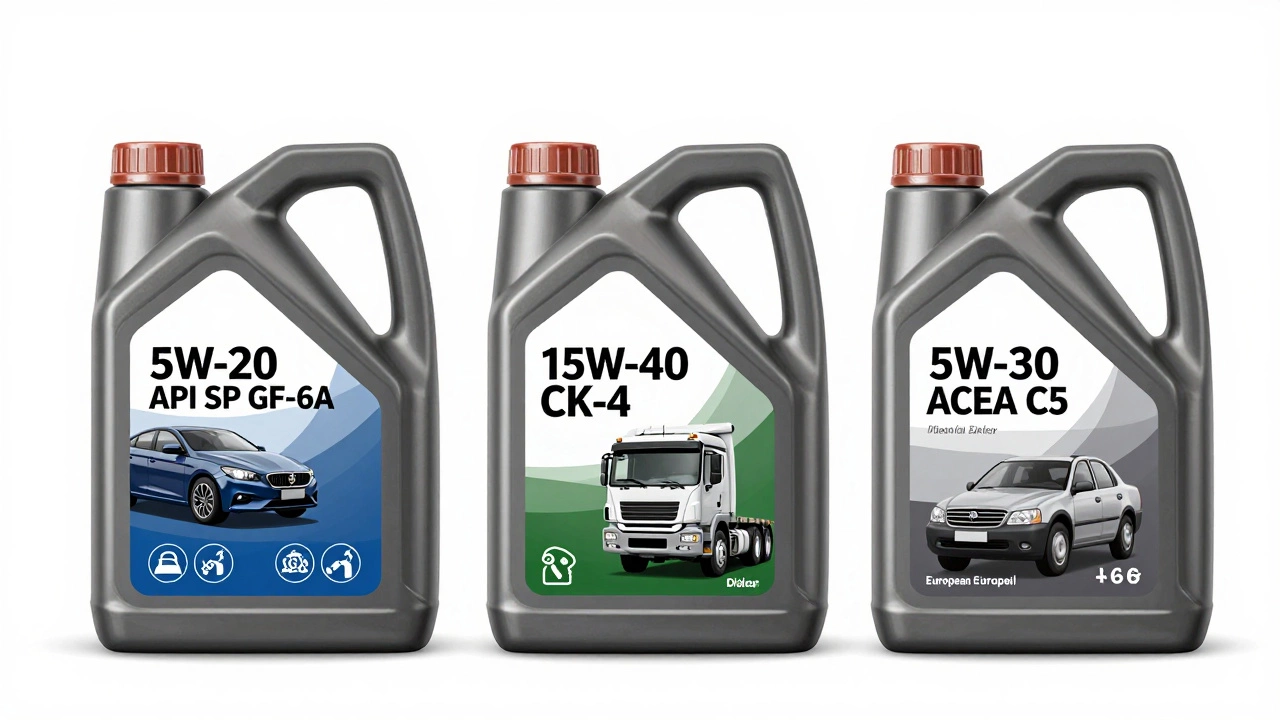
Using an old API rating (like SM or SL) in a newer car can cause problems with turbochargers, direct injection, or exhaust after-treatment systems. In fact, the European Automobile Manufacturers’ Association (ACEA) has its own standards (A3/B4, C3, C5) for cars sold in Europe. If you drive a BMW, Mercedes, or VW, you might need ACEA C5 - not just API SP.
Synthetic vs. Conventional - What’s the Real Difference?
Conventional oil is refined from crude. Synthetic oil is engineered in a lab. Synthetic doesn’t mean “premium brand.” It means the molecules are uniform, clean, and stable. That gives you better flow at cold temps, longer life, and better protection under stress.
Most cars made after 2010 require synthetic oil. If your manual says “synthetic only,” don’t use conventional. You’ll void your warranty and risk engine failure. Even if your car is older, switching to synthetic is usually safe - and often improves performance. The only exception? Very high-mileage engines (over 200,000 km) with leaks. Some mechanics recommend switching to a high-mileage blend with seal conditioners to reduce leaks.
Don’t Ignore Your Engine Type
Not all engines are the same. Turbocharged engines run hotter. Direct injection engines get carbon buildup. Diesel engines need different additives. Here’s how to match oil to engine type:
- Turbocharged engines - Need oils with high thermal stability. Look for API SP or ACEA C3/C5.
- Direct injection (GDI) - Require low-ash oils (like API SP with GF-6A) to prevent carbon deposits on intake valves.
- Diesel engines - Use CK-4 or FA-4. Never use gasoline engine oil in a diesel.
- Older carbureted engines - May need higher zinc content (ZDDP). Some high-performance or classic car owners use oils labeled “Classic” or “Vintage.”
Ignoring these differences is like putting diesel fuel in a petrol car. The damage isn’t always immediate, but it’s inevitable.
What About Oil Brands?
Brand doesn’t matter as much as you think. Castrol, Mobil 1, Shell, and Pennzoil all make oils that meet API and ILSAC specs. The real difference is price and additives - not performance. A $20 bottle of API SP 5W-30 synthetic from a generic brand is just as good as a $40 name-brand bottle - if both have the same ratings.
Only pay extra if:
- Your car requires a specific OEM approval (like VW 502.00 or BMW Longlife-04)
- You drive in extreme heat or cold
- You tow heavy loads regularly
Otherwise, stick to the numbers. The oil inside is the same.
When in Doubt - Check the Dipstick or Cap
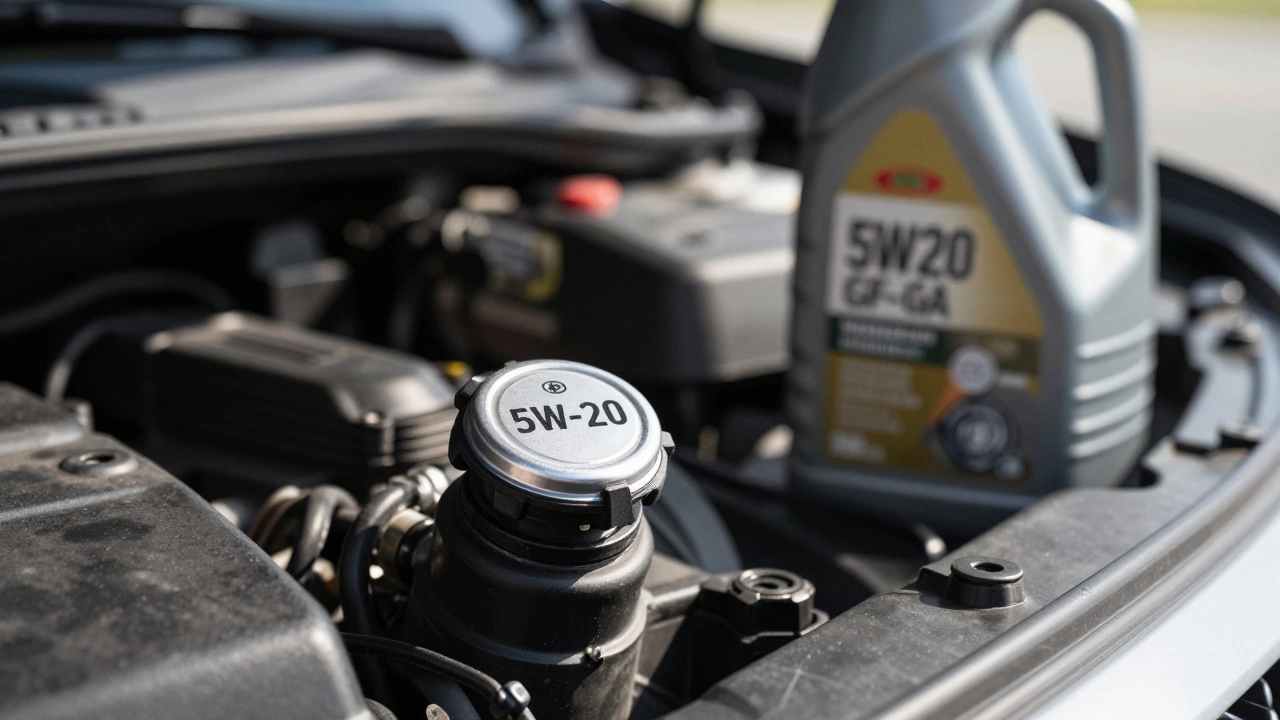
Many modern cars have the recommended oil viscosity printed right on the oil filler cap. Look for a small label - it’s often 5W-30 or 0W-20. If it’s faded, check under the hood near the cap or in the glovebox. Some manufacturers even print it on the inside of the fuel door.
If you can’t find it anywhere, call your dealership. Give them your VIN (Vehicle Identification Number). They’ll pull up the exact specification. No guesswork needed.

Common Mistakes (And How to Avoid Them)
- Using 10W-40 because “it’s thicker and better” - It’s not. Modern engines need thin oils for efficiency.
- Buying “high mileage” oil for a new car - High-mileage oils have seal conditioners that can harm newer engines.
- Using diesel oil in a petrol engine - Diesel oils have higher detergent levels that can damage catalytic converters.
- Assuming all “synthetic” oils are the same - Always check the API and ILSAC ratings.
The bottom line? Your car doesn’t care about brand loyalty. It cares about chemistry. Get the viscosity right. Get the API rating right. Get the type right. Everything else is noise.
Quick Reference: What to Look For
Before you buy oil, check for these three things:
- Viscosity - e.g., 5W-30 (match exactly)
- API Service Rating - e.g., SP (latest for petrol)
- ILSAC Rating - e.g., GF-6A (standard for 2020+ cars)
If your car is from Europe, also check for ACEA rating - like C3 or C5.
| Vehicle Type | Recommended Viscosity | API Rating | ILSAC Rating | Special Notes |
|---|---|---|---|---|
| 2020+ Gasoline Cars | 0W-20, 5W-20, 5W-30 | SP | GF-6A | Use only synthetic |
| Pre-2010 Gasoline Cars | 5W-30, 10W-40 | SN or SP | GF-5 or GF-6A | Conventional OK if manual allows |
| Turbocharged Engines | 5W-30 | SP | GF-6A | High thermal stability required |
| Diesel Trucks (2017+) | 5W-40, 15W-40 | CK-4 | N/A | Never use gasoline oil |
| European Cars (BMW, VW, Mercedes) | 5W-30, 0W-20 | SP | GF-6A | Must also meet ACEA C3/C5 |
Frequently Asked Questions
Can I use 5W-30 instead of 5W-20?
It’s not recommended. 5W-20 is thinner and flows faster at startup, which reduces wear in modern engines. Using 5W-30 may lower fuel economy, increase engine load, and could trigger warning lights. Only switch if your manual explicitly allows it.
Is synthetic oil worth the extra cost?
Yes, if your car requires it. Synthetic lasts longer, flows better in cold weather, and protects better under heat. For cars made after 2010, it’s not optional - it’s required. Even for older cars, synthetic often extends engine life. The extra $5-$10 per oil change is cheap insurance.
Can I mix synthetic and conventional oil?
Technically, yes - they’re chemically compatible. But it defeats the purpose. Mixing them dilutes the benefits of synthetic. If you’re low on oil, topping up with conventional is fine in an emergency. But get a full synthetic change as soon as possible.
What if my manual says “API SN” but I only see “SP” on the shelf?
You can use API SP. SP is the newer standard and backward-compatible. It meets or exceeds SN performance. In fact, API SP was designed to replace SN. If your car is from 2015 or later, SP is the better choice.
Do I need to change oil more often if I use conventional?
Yes. Conventional oil breaks down faster. If your manual says “change every 10,000 km” with synthetic, you might need to change every 5,000 km with conventional. Always follow the manual’s recommendation for your oil type - don’t assume all oils last the same.
Final Tip: Keep a Record
Write down the oil type you used each time. Take a photo of the bottle. Note the date and mileage. That way, if you ever have engine trouble, you’ll know exactly what went in. Mechanics will thank you. And you’ll avoid the “we used the wrong oil” blame game.