Suspension Risk & Cost Calculator
Select the symptoms you are currently experiencing to calculate your immediate risk level and potential financial impact.
Analysis Results
Select symptoms to see analysis.
Estimated Financial Impact
Your car feels like it’s floating on a boat. Every pothole sends a jolt through your spine, and the steering wheel vibrates in your hands whenever you hit a bump. You’ve noticed the noise, felt the instability, and maybe even seen one corner of the vehicle sagging lower than the others. The immediate question popping into your head is simple but critical: can I drive with bad suspension?
The short answer is no, you shouldn’t. While your car might physically move forward for a few more miles or even days, driving with a compromised suspension system is a complex network of springs, shocks, and struts that connects your vehicle's wheels to its frame is playing Russian roulette with your safety and your wallet. It turns a manageable repair bill into a catastrophic mechanical failure.
The Immediate Dangers of Driving on Failing Suspension
When people ask if they can drive with bad suspension, they are usually looking for permission to delay a repair until payday. But the risks aren't just about comfort; they are about physics. Your suspension does two main jobs: it keeps your tires in contact with the road, and it absorbs energy from bumps so your chassis doesn't take the beating.
When those components fail, control slips away. If your shock absorbers are hydraulic cylinders that dampen the oscillation of springs are shot, your tires bounce excessively after hitting a bump. This means there are split seconds where your tire loses grip with the pavement. In an emergency stop or a sudden swerve to avoid a deer, that loss of traction is the difference between stopping safely and sliding into oncoming traffic.
Then there is the issue of alignment. A broken strut or worn control arm changes the geometry of your wheel. Suddenly, your car pulls hard to the left or right. You have to fight the steering wheel just to go straight. This isn't just annoying; it fatigues the driver quickly, leading to mistakes. On highways, this instability becomes deadly at speeds above 60 mph. One uneven patch of road can cause the vehicle to fishtail, especially if you are carrying passengers or cargo.
How Bad Suspension Destroys Other Car Parts
Here is the part that hurts the most financially: driving with bad suspension acts like a disease that spreads to other healthy organs of your car. You might think you’re saving $300 by delaying the fix, but you could be signing up for a $1,500 bill within a month.
The first victim is almost always your tires. When the suspension can’t keep the tire flat against the road, the tread wears unevenly. You’ll see "cupping" or "scalloping"-patches of bald rubber separated by high spots. This happens because the tire slaps against the pavement repeatedly instead of rolling smoothly. Replacing four tires because of neglected shocks costs far more than the shocks themselves.
Next, the stress travels up to the ball joints and tie rods. These small metal connectors allow your wheels to turn and move up and down. If the suspension is loose, these joints absorb impacts they weren't designed to handle. A failed ball joint while driving can cause the wheel to collapse entirely, locking your steering or detaching the wheel from the car. That is not a repair you can make on the side of the highway.
Finally, consider the CV axles and wheel bearings. Excessive play in the suspension puts lateral stress on these rotating parts. Premature failure here leads to grinding noises, vibration, and eventually, a seized wheel. By ignoring the initial squeak of a worn bushing, you risk destroying the entire front-end assembly.

Symptoms That Mean You Must Stop Driving Immediately
Not all suspension issues are created equal. Some are annoying; others are emergencies. You need to know the difference to decide whether you can limp to a mechanic or need a tow truck.
If your car makes a loud clunking or banging noise when going over speed bumps, that is a warning sign. It usually indicates a broken spring, a loose control arm bolt, or a failed strut mount. However, if you hear a constant knocking sound that gets worse as you accelerate, or if the steering wheel shakes violently without any input from you, do not drive further. These are signs of imminent structural failure.
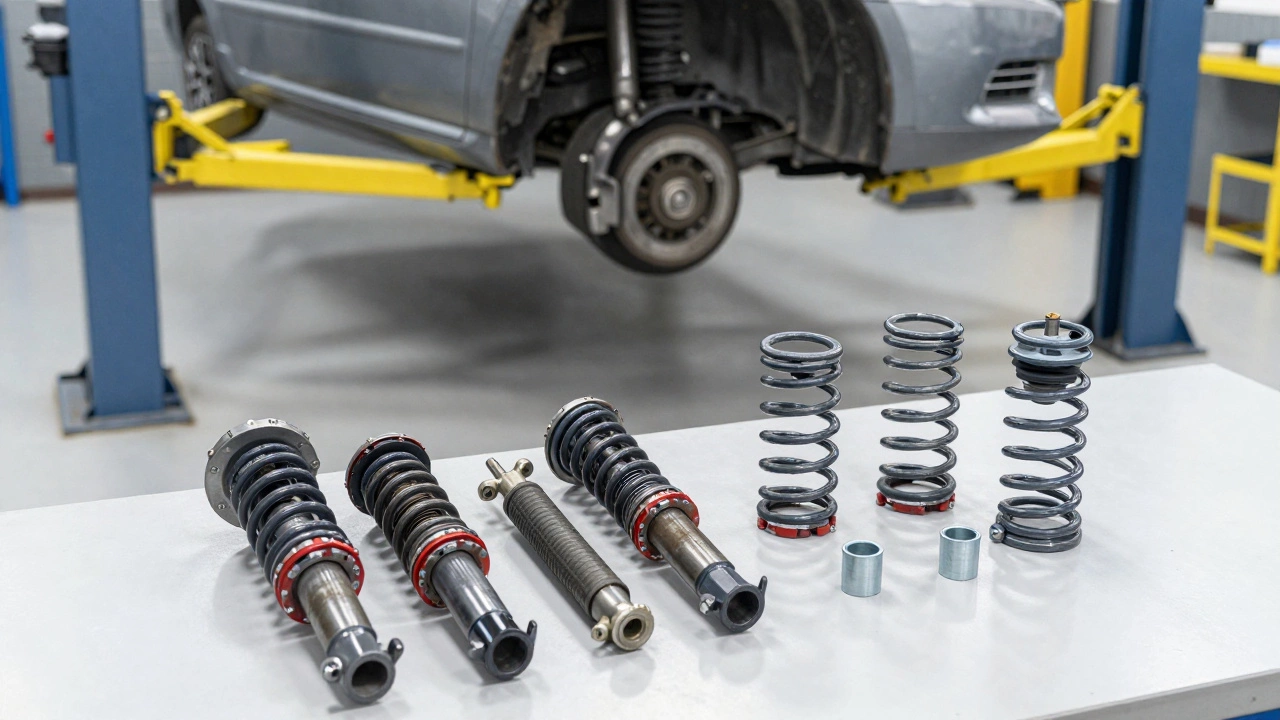
Look at your car when it is parked on level ground. Does one corner sit significantly lower than the others? This suggests a broken coil spring. Springs carry the weight of the vehicle. If one breaks, the remaining three are working overtime, and the alignment is completely off. Driving on a broken spring can damage the fender, the brake lines, and the exhaust system as the wheel sits too low and rubs against body panels.
Another critical test is the "bounce test." Push down firmly on each corner of your car and let go. The car should bounce up and settle back down once. If it continues to bounce up and down multiple times, your shock absorbers have lost their damping ability. While you can technically drive a short distance with this symptom, you are severely compromising braking distance. Wet roads become ice rinks under these conditions.
The Cost-Benefit Analysis: Repair vs. Replace
Let’s talk numbers. In 2026, labor rates for automotive repair have stabilized slightly, but parts costs remain high due to supply chain adjustments. A standard set of rear shock absorbers might cost between $150 and $400 for parts, plus labor. Front struts, which are more complex because they hold up the engine bay structure, often run $300 to $800 per side including installation.
If you ignore this, what is the alternative? Consider the cost of a new set of tires ($600-$1,200) plus an alignment service ($100-$150). Add in the potential cost of replacing ball joints, tie rod ends, and sway bar links that wear out faster due to the rough ride. Now add the deductible if you get into an accident because you couldn't stop in time. The math is brutal. Preventative maintenance is always cheaper than reactive disaster management.
Furthermore, older vehicles often suffer from rusted mounting points. If your car is over ten years old, the mechanic might find that the strut towers are corroded. Fixing that requires welding and fabrication, pushing the price well into the thousands. Catching suspension issues early prevents secondary corrosion damage caused by leaking fluids or misaligned frames.
| Issue | Immediate Risk | Secondary Damage | Estimated Repair Cost (Parts Only) |
|---|---|---|---|
| Worn Shock Absorbers | Reduced braking, poor handling | Tire cupping, bearing wear | $150 - $400 |
| Broken Coil Spring | Vehicle sag, rubbing parts | Fender damage, exhaust bend | $100 - $300 |
| Failed Ball Joint | Wheel detachment, loss of control | Steering knuckle damage | $50 - $150 |
| Worn Control Arm Bushings | Noise, vague steering | Alignment drift, tire wear | $80 - $200 |
When Is It Safe to Drive to the Mechanic?
We live in the real world, and sometimes you have to drive to the shop. If your symptoms are mild-such as a slight increase in road noise, minor bouncing after bumps, or a subtle pull to one side-you can likely drive carefully to a repair facility. Keep your speed below 45 mph, avoid aggressive steering inputs, and give yourself extra following distance. Braking distances will be longer, so start slowing down earlier than usual.
However, if you experience any of the following, call a tow truck:
- A visible leak of hydraulic fluid from the shocks or struts.
- A loud metallic clunking sound that occurs with every bump.
- The car pulling so hard to one side that you must hold the wheel crooked to go straight.
- One wheel sitting visibly lower than the others.
- Vibration in the steering wheel that increases with speed.
Tow trucks are expensive, yes. But a single accident negates the savings instantly. Insurance may cover towing if it’s deemed a safety hazard, so check your policy. Many roadside assistance plans include free towing up to certain miles. Use them.
Maintenance Tips to Extend Suspension Life
You can’t stop wear and tear entirely, but you can slow it down. First, pay attention to how you drive. Hitting curbs, speeding over potholes, and taking speed bumps at full throttle destroy suspension components. Slow down before obstacles. Let the car roll over them gently rather than slamming into them.
Second, get regular alignments. Even if nothing feels wrong, having your alignment checked every 10,000 miles or during tire rotation ensures that forces are distributed evenly across the suspension. Misalignment accelerates wear on bushings and ball joints.
Third, inspect your tires regularly. Uneven tire wear is the earliest visual indicator of suspension trouble. If you see bald spots on the inside or outside edges of your tires, your camber or toe settings are off, pointing to a failing component somewhere in the suspension chain.
Finally, don’t overload your vehicle. SUVs and trucks are built to carry weight, but exceeding the rated capacity compresses the springs beyond their design limits. This causes premature fatigue in the metal and overheating in the shock absorbers. If you’re hauling heavy loads frequently, consider adding air helper springs or upgrading to heavy-duty shocks designed for towing.
How long can I drive with bad shock absorbers?
You should not drive more than a few miles with known bad shocks. While the car will move, your braking distance increases by up to 20%, and tire wear accelerates rapidly. If the shocks are leaking or making noise, limit travel to the nearest repair shop at low speeds.
Does bad suspension affect gas mileage?
Yes. Poor suspension causes uneven tire wear and incorrect alignment, which increases rolling resistance. Your engine has to work harder to push the car forward, reducing fuel efficiency by 5-10% in severe cases.
What is the most common suspension failure?
Worn shock absorbers and strut mounts are the most frequent failures. They degrade over time due to heat, dirt, and constant compression cycles. Rubber bushings also wear out, causing noise and looseness in the steering.
Can I replace just one shock absorber?
It is highly recommended to replace shocks and struts in pairs (both front or both rear). Mixing old and new components creates uneven handling, causing the car to pull to one side and creating unpredictable behavior during cornering.
Is it dangerous to drive with a broken sway bar link?
It is not immediately life-threatening, but it is unsafe for dynamic driving. A broken sway bar link causes excessive body roll during turns and may produce rattling noises. It reduces stability during evasive maneuvers and should be repaired promptly.